Pay Down the Mortgage or Keep Investing? A FIRE Decision Framework
Paying down a mortgage and continuing to invest are not decided by comparing two rates alone. Use cash flow, safety margin, liquidity, and risk tolerance to choose a FIRE path.
Fire Path
Fire Path is more than a FIRE calculator. It combines scenario planning, comparison, asset management, history, and long-term tracking in one product.
The website should do more than explain concepts. It should help high-intent visitors understand the product quickly, then move into the app.
Plan clearly
Use six FIRE modes and comparison views to see which strategy fits your path best.
Track progress
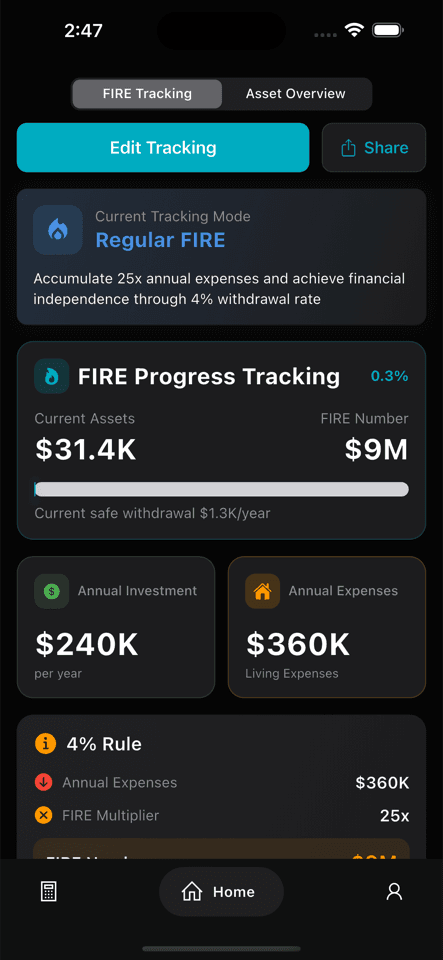
The home dashboard connects current assets, FIRE target, and progress in one repeatable view.
Manage better
Asset management, multi-currency overview, and saved scenarios turn planning into an ongoing system.


See the core product capabilities clearly
Fire Path now goes well beyond a simple FIRE calculator by combining planning, comparison, asset management, and repeatable progress tracking.
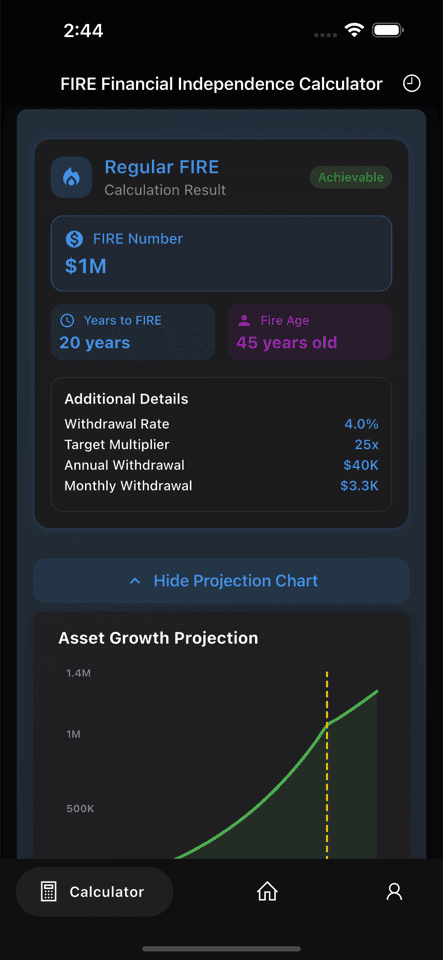
Estimate different retirement paths from traditional to passive-income-first planning.
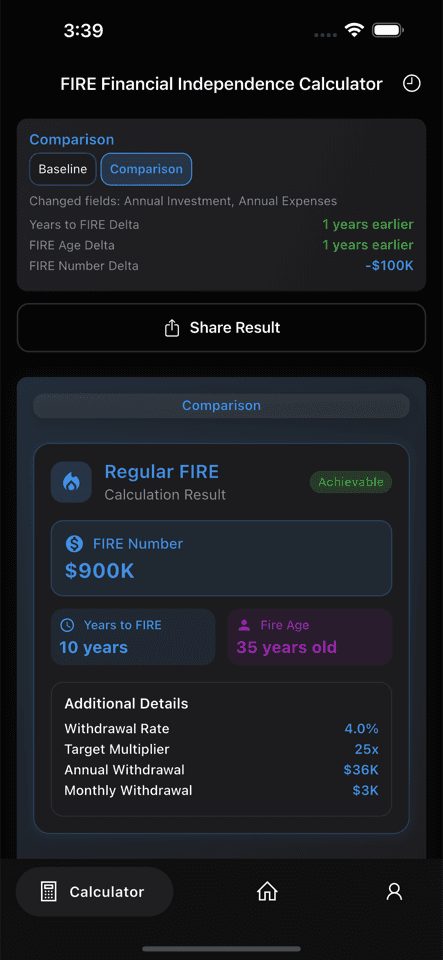
Compare assumptions, strategies, and timelines in one clearer decision view.
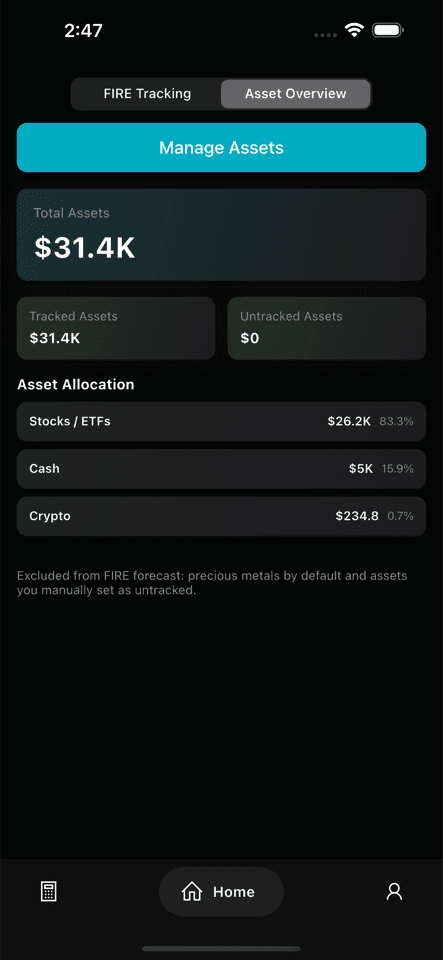
Bring tracked assets, allocation, and asset visibility into the same planning system.
Review total assets and tracked assets in one display currency with cleaner context.
Use current assets, FIRE target, and progress as a daily tracking surface.
Save scenarios and revisit earlier plans instead of starting from scratch each time.
Product Walkthrough
Fire Path is more than a calculator. It combines planning, comparison, asset tracking, and repeatable progress management.


Calculate your FIRE target, years to FI, and FIRE age with six planning modes instead of relying on a single rough estimate.
Turn retirement ideas into a clear planning target.


See how different assumptions, contribution levels, and FIRE modes change the timeline before you commit to one strategy.
Make trade-offs visible before they become costly decisions.


The home dashboard brings together current assets, FIRE target, and progress so your plan stays visible over time.
Move from one-time calculation to ongoing tracking.


Organize tracked assets, allocation, and total holdings in one place with a unified display currency for a clearer asset picture.
Connect asset management directly to FIRE planning.
Our calculations and articles use adjustable assumptions to show result differences, such as investment returns, withdrawal strategies, and expense changes. Living conditions vary greatly, so we prioritize 'understanding models and limitations' over pursuing a single answer. You can use the content here as a starting point for building a planning framework, then adjust and verify based on your own situation.
Learn more: Methodology & AssumptionsFIRE (Financial Independence, Retire Early) is often translated as 'Financial Freedom, Early Retirement', but its focus is not just 'Retirement', but giving you more freedom in life choices: you can choose to work, or choose to pause; pursue a more meaningful career, or save time for family, health, and hobbies.
Most people use 'Withdrawal Rate' to estimate the assets needed for FIRE. A common practice is to calculate target assets based on annual expenses. For example, if you need $60k a year, assuming a conservative withdrawal strategy, you get a 'target asset range'. But what's often overlooked is that everyone's FIRE number depends on assumptions: will your expenses change with age? do you have a mortgage? market volatility, inflation, and additional income sources.
Therefore, 'FIRE Calculation' is not about getting a magic single number, but establishing a set of discussable and adjustable assumptions, and verifying them repeatedly under different scenarios: is the plan still valid if returns drop? if expenses rise? if you stop investing or change jobs? When you include these factors, FIRE turns from a slogan into an executable roadmap.
On this site, you will see articles ranging from FIRE basics, route comparisons (Lean/Barista/Fat FIRE), to common calculation errors and scenario simulations. You can also use our tools to apply the same methods to your own numbers, quickly viewing the differences in results under different assumptions.
Featured Core
These are the core pages of the site and are updated regularly. Start here for the best reading flow.
Core article, recommended first reading.
Latest from our blog
Insights, strategies, and tips for your FIRE journey.
Paying down a mortgage and continuing to invest are not decided by comparing two rates alone. Use cash flow, safety margin, liquidity, and risk tolerance to choose a FIRE path.
Households often stall on reduced-hours decisions because goals conflict. Use survival, stability, and optionality layers plus four floors to turn expectations into a practical agreement.
Reducing work hours changes household income, benefits, care work, and the FIRE timeline. This framework uses numbers, a trial period, and exit conditions to make the decision reversible.
Articles help you build understanding. The tool page is where that understanding becomes a repeatable planning flow you can compare, refine, and continue inside the app.